
Uncertainty, risk, and control
If we look back in history, until today, we see that many of our organisational models, structures and decision making are based on the industrial era. In that era, we started to standardise processes, with the aim of predictability, efficiency and control. Changes were made in a logical step by step way, focused on manageable throughput.
With internal control also risk management stepped into our organisations. The invention of formal methods of oversight transformed governance into a structured, mathematical, and highly institutionalised discipline.
Before that era, risk was managed through gut instinct, intuition, trade diversification, etc. But with a larger, growing workforce, leaders weren’t able to personally oversee production, transaction and interaction. Audits and inventory checks became mainstream.
Nowadays, and especially after the covid pandemic, we realise the interconnectivity and interdependence between our global systems. Problems are often not that simple and isolated anymore. They can have cascading impact on people, communities, organisations, countries, economies and the globe.
With that, we know we are in a continuous changing world and that uncertainty is not going away. It’s part of our society (read more about VUCA here). And that means also: part of our business environments. In other words, with change comes uncertainty and with uncertainty comes the possibility of risks that can disrupt any status quo or BAU.
According to strategic management scientists David Teece et al., uncertainty is different from risk, as risk can be modelled with traditional tools, while uncertainty requires a high level of dynamic capabilities and organisational flexibility. Such dynamic capabilities allow an organisation to adapt internal resources and processes to changes in the external environment (Azizov, 2025).
If we look at many current risk management systems and other attempts to predict the (uncertain) future, they are still mainly based upon linear relationships derived from past experience. But the nature of our nowadays complex, non-linear systems not always has a definite or repeatable cause-and-effect relationship. So, instead, we should embrace uncertainty, adapt, and turn the unknown into an opportunity.
I remember that during the pandemic, we organised two large video sessions with design professionals from around the world. The words that were mentioned many times were ‘resilience’ and ‘adaptability’. And that is exactly what organisations need when dealing with uncertainty, which also includes the continuous-changing customer needs, interests, contexts (as they are related with the interconnected changes in society as I mentioned before). As (service) design professionals we shouldn’t step into the trap of talking about risk management or risk control. Control is the opposite of resilience and adaptability. It’s almost as if we are resisting and fighting against change. But change and the uncertainty of the outcome, are an opportunity for innovation.
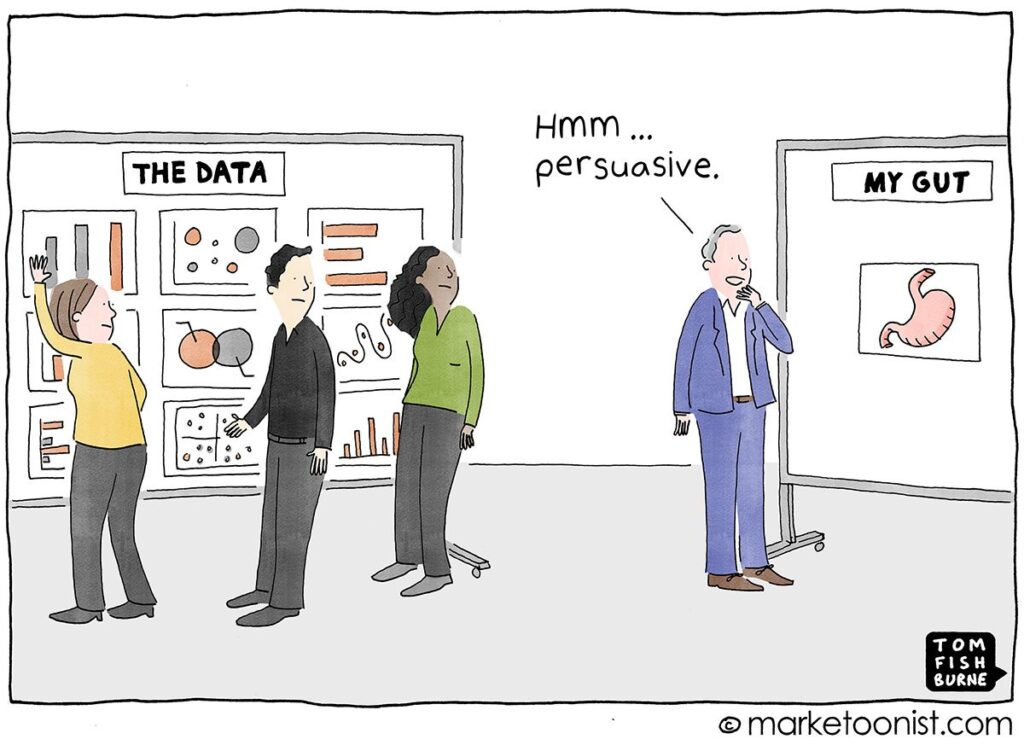
Why I mention this, is that customers and their behaviour can also be seen or treated as ‘risk factors’. And that is why there is an extremely large number and types of customer data collected, so that we can predict, push, and seduce. We even mislead, hide important information, and ‘forget’ to inform. That, of course, is not in the customer’s favour, let alone ‘serving the customer with your best intentions’. Even if SoC is low, you treat the customer with the highest respect and honesty. But data, like technology can be leading in the decisions being made.
On top of that, in an effort to manage or control every customer action, different departments can deploy their own, isolated tools and with that their own set of customer data. This not only leads to data overload, but even worse, leaves customer identity fragmented across dozens of un-synced databases and spreadsheets, generating innovations in different directions, isolated and incremental improvements, etc. Plus, there is a huge hunger for so-called ’signal control’; red flags or anything that real-time show risks that need to be solved ‘immediately’. In this hunger for control and the over-collection of customer data, the customer and their needs may be overlooked, or fragmentary solved.
I believe that the current availability of data means that teams in an organisation can always find information and statistics that touch their role, goals or KPIs. While it’s a good thing that they want to improve their performance metrics, this fragmentation is contra productive. It’s often seen, when for instance there is no full overview of a customer journey or more importantly the customer lifecycle.
We must be willing to hold uncertainty without retreating into premature control. We need a better understanding of uncertainty, adaptability and resilience, and should design for resilient services and service systems.