The voice of the customer
The terminology ‘Stake of the Customer’ may be confused with ‘Voice of the Customer’. Although there is a relationship between the two, they differ.
Let’s first look at VoC. Often, VoC programs are about listening to the customer. To give a definition: VoC is about systematically listening to the customer across the places where the customer’s voice naturally appears, turning those signals into an understanding of customer needs or problems, and ‘injecting’ that understanding into the organisation and the teams that are responsible for designing, developing, delivering and maintaining the organisation’s products and services.
In fact, this is a continuously looping process, which often follows the the following steps: LISTENING → UNDERSTANDING → PRIORITISING → ACTING → MEASURING → LISTENING AGAIN
VoC doesn’t necessarily uncover the deepest need, but indicates a problem that hinges that need. To give you an example: A customer may say: “I need faster reporting”. Their underlying need may be: “I need confidence that I know what is happening in my business”. Or: “I need to spend less time preparing management meetings”. Or: “I need to make decisions faster”.
Customers can report what they experience and perceive. Their ‘voice’ can be heard via for instance support tickets, live calls and chats, online reviews, rating platforms, social media, website feedback, NPS, CSAT and CES. It guides the organisation to improve what goes wrong with (the use of) their products and services. The customer provides input, feedback, concrete needs, complaints, preferences, etc. But listening doesn’t imply that the customer has a ‘stake’ or what ‘stake’ they have.
A voice is something you hear. A stake is something that matters to an actor because they are affected by the outcome. In other words, hearing the customer’s voice, doesn’t mean that the customer gets what they want. In contrast to VoC, SoC indicates how relevant their needs are and how much those are taken into account. SoC is about the customer’s position within the business model, operating model, products, services and actions. A customer’s stake can therefore exist independently of whether it has been articulated by the customer.
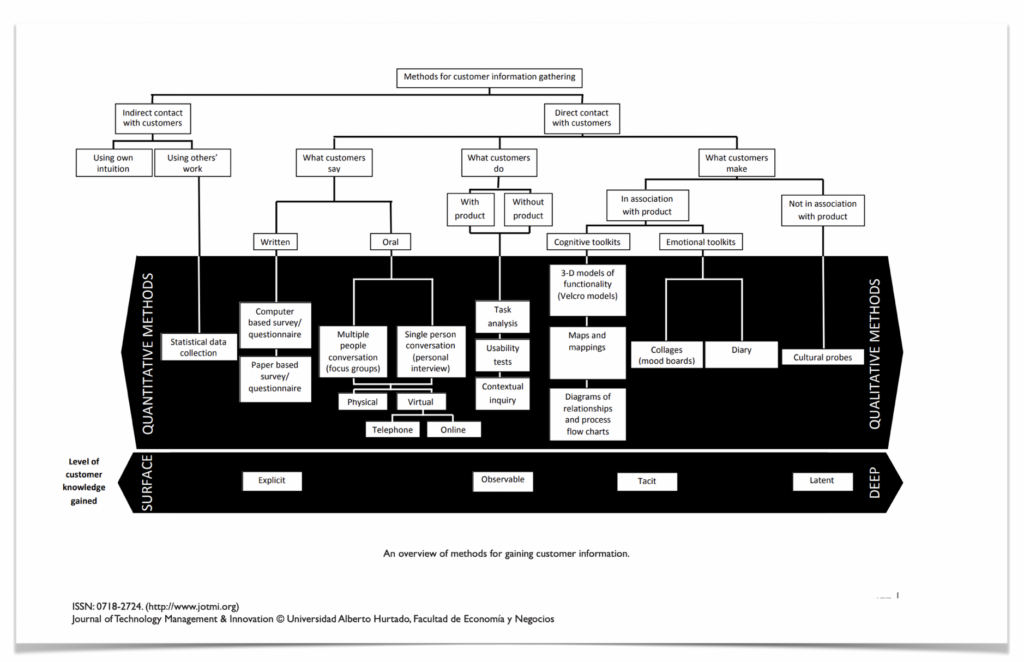
In my research, I found an old article written by Tonje Overvik Olsen and Torgeir Welo: ‘Maximizing Product Innovation through Adaptive Application of User-Centered Methods for Defining Customer Value’ (2011). They state:
The methods in use for gaining customer insight and identifying customer needs are numerous. This figure gives an overview of important methods for identifying customer needs. Each individual method possesses different characteristics, both advantageous and disadvantageous. Moreover, they are suitable of revealing different types of information at various knowledge depth levels, from quantitative (e.g. what functions and features a product should hold) to qualitative (e.g. emotions and deeper meanings in relation to a product). Choosing the most suitable method(s) to gather the necessary customer information for a specific product development project is vital for success in innovation.