
The customer in SoC
Stake of the Customer (SoC) indicates the extent to which the customer’s needs, context, jobs, desired outcomes, priorities and interests are taken into account, and the weight given to them, in the design of an organisation’s business model and operating model.
SoC does not ask whether an organisation puts ‘the customer’ first. It examines which aspects of the customer’s stake are taken into account in the organisation’s model, where they are reflected, and the weight they are given relative to other considerations.
The term ‘customer’ in SoC may be confusing, as it doesn’t focus on one (type of) customer, or one customer segment, or ‘the main customer’. Like personas (I prefer: archetypes), value is created around specific needs, jobs, etc. And those can come and go, and one customer can have different interests, needs or jobs to be done over the span of a day, week, year or even lifetime. And of course the word ‘customer’, may not always be used by an organisation.
Let’s give an example:
A Dutch woman lives in the city of Amsterdam. She already had a passport, but it has expired and needs to be renewed. The reason is that she is getting married in three months time. And after her honeymoon trip to Paris, she will finish the baby bedroom, as she is expecting her first child two months after their trip. For sure, after birth, she will complete the birth registration and request a Social Security number.
Some of the woman’s needs (as a resident of the city of Amsterdam and a ‘customer’ of the Government of Amsterdam) are life event related and happen once or only a few times in a lifetime. But paying her monthly waste collection tax, happens more often. And complaining about the waste not being collected hopefully never.
So, for a city government, the SoC question to ask is:
Which needs, contexts, jobs, desired outcomes, priorities and interests of the city’s residents, businesses and visitors are taken into account, and with what weight, in the design of the city’s services and operating model?
Let’s continue with the example.
The lady is taking the metro each day to go to work. How is the city’s public transport model designed? Different aspects of the customer stake might include:
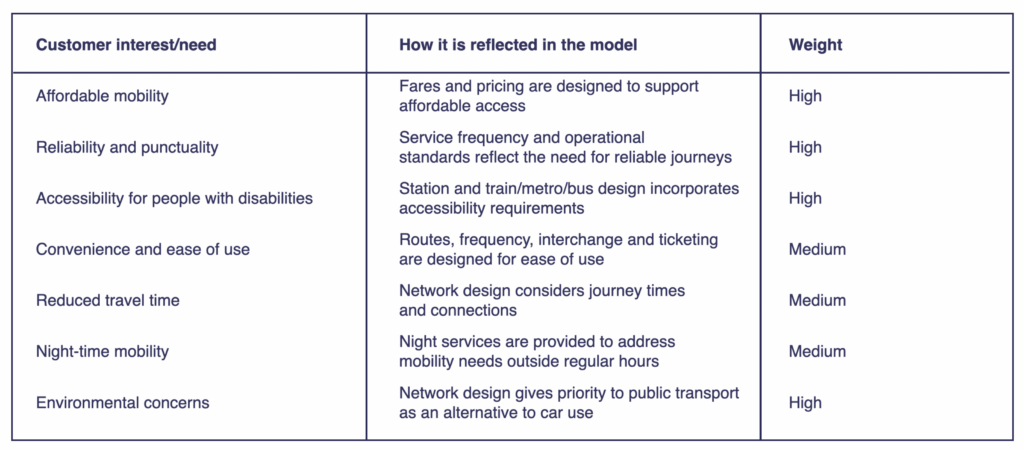
If we look at ‘Environmental concerns’, this customer interest/need is strongly taken into account in the design of the public transport model. And in line with the city’s policy to reduce car dependency, for instance residents’ preference for preserving free on-street parking is not taken into account at all. It receives no weight in the model.
And if we look at ‘Convenience and ease of use’, this interest/need is also taken into account (medium weight). However, for instance residents’ preference for having a metro station within a five-minute walk of their home, may not be taken into account at all; other stakes, such as network-level demand and connectivity, may take precedence.