
Measuring what matters: the limitations of NPS
I clearly remember when I first critically reflected on and talked about the Net Promoter Score. It was in 2010. I had read Tim Brown’s book ‘Change by Design’ and became skeptical about the growing use of NPS as a definitive indicator of customer experience. While Brown doesn’t address NPS directly, his emphasis on deep contextual understanding, human-centred insight, and iterative learning highlights key tensions with NPS’s simplistic, one-question approach.
More recently, I heard in this podcast that still two-thirds of Fortune 1000 companies rely on NPS to gauge customer satisfaction and loyalty. While NPS can provide some insights, it has significant limitations that can lead to misinformed CX and service innovation strategies if relied on too heavily. Also have a look here.
I am truly wondering how CX and service design professionals and any other strategic professional consider NPS as a serious OKR. According to the authors of the article I mentioned in a previous post, “these metrics often prioritise the analytical evaluation of results to measure productivity and profitability against business goals, rather than supporting the iterative and synthesis-oriented design process required to address the goals of various stakeholders.”
Sources of data, metrics, KPIs, OKRs, and strategic alignment approaches; they all play a role. They ensure your service innovation program is grounded in meaningful, current data about customer reality. But I agree with Jeff Gothelf, when he states that NPS is a waste of time. Have a look at the following image from Jeff’s article.
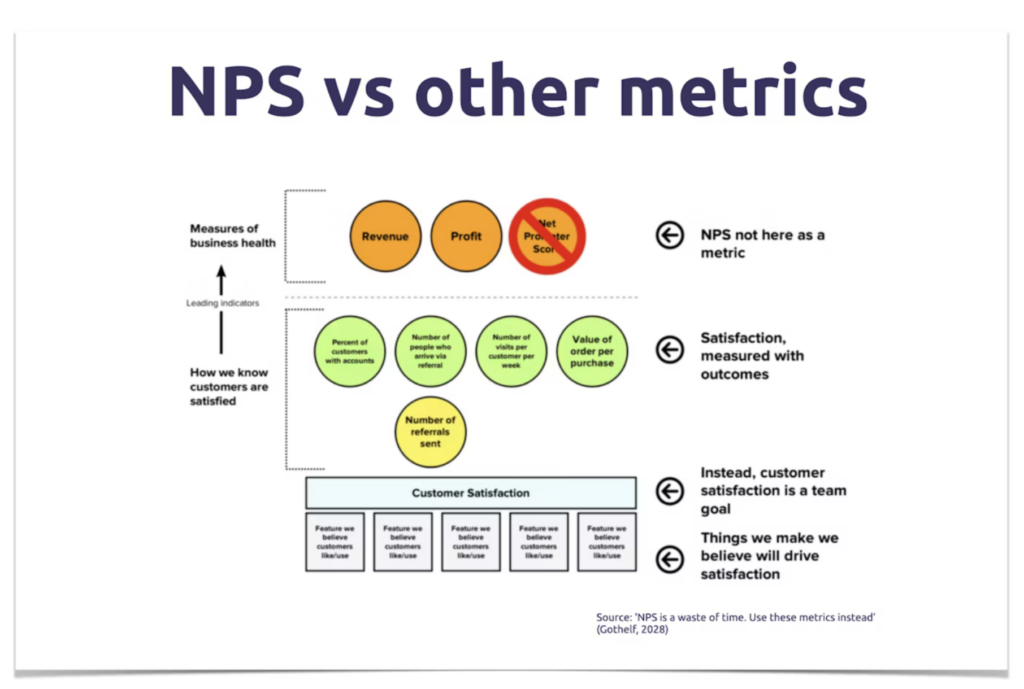
In the article Why on Earth Are We Still Using NPS?, Phil Araujo dissects the illusory effectiveness of NPS:
NPS hangs its hat on the question, “How likely are you to recommend our product?” This is a forecast, a speculation, a crystal ball question. NPS gives you a score, a number, and a single data point. It’s not going anywhere until you dig deeper.
NPS, like customer satisfaction (CSAT) and Customer Effort Score (CES), are valuable, but backstage metrics related with process efficiency, staff satisfaction, error rates, cost savings, and complaint handling are equally important. As Zack Hamilton is stating:
CEOs don’t want to hear about a 3-point NPS lift. They want to know:
- Why margin is bleeding in returns and refunds
- Why first-time buyers don’t come back
- Why conversion rates drop after support interactions
- Why repeat purchase cycles are getting longer.
And most CX leaders can’t answer any of it. Because their system wasn’t built to. They’re still chasing sentiment while the business is chasing outcomes.
Remember what Matthew Dixon, Nick Toman, and Rick DeLisi state in ‘The Effortless Experience: Conquering the New Battleground for Customer Loyalty’? They debunk the myth that organisations need to constantly ‘dazzle’ or ‘wow’ customers to build loyalty. Instead, the authors prove through their research that the true driver of customer retention is simply reducing friction and making the experience as effortless as possible.
Appetite for more? Have a look here: NPS Is The Worst.